
There is a lot of information emerging about the ethical and responsible use of artificial intelligence (AI), particularly in the fields of art, media and publishing. For example, spelling out the authorship responsibility, like this webpage about author submissions from the Emerald Group Publishing which has very clear guidelines about what AI can and cannot be used for in the writing process.
AI is already being used by students at all levels of education whether or not their educators support these tools. Many artists like Mez Breeze have already been on the bleeding edge of this mass proliferation of AI tools, exploring how they can be integrated into creative practice. Also, Treecreate partners Awhiworld are actively working to educate people about how to critically and creatively use AI in their work.
We recently leaned into AI for a logo design for Weaving Water, Treecreate’s primary ongoing project. And although relatively happy with the result we felt like it needed to be better woven into the story in several ways. The first way is the weaving together of imagery. The other aspect is the cognition that whenever we use AI and indeed whenever we use the internet via broadband and mobile networks there is an environmental cost. This is a subject we plan to explore in future posts.

The use of water to generate AI is an invisible cost which is having an impact on the availability of clean water, AI’s excessive water consumption threatens to drown out its environmental contributions. Gupta, Bosch and van Vliet (2024) comment that “initial research shows that AI has a significant water footprint. It uses water both for cooling the servers that power its computations and for producing the energy it consumes. As AI becomes more integrated into our societies, its water footprint will inevitably grow.”
They go on to say “the growth of ChatGPT and similar AI models has been hailed as “the new Google.” But while a single Google search requires half a millilitre of water in energy, ChatGPT consumes 500 millilitres of water for every five to 50 prompts. This is quite a significant difference and we wonder how other search engines such as Ecosia stack up in comparison? We can keep track of Treecreate’s AI usage at this point but what is the average searches people make in one day? 20? 50? 100?
We were curious about how AI sees its own consumption of water so we created in openart.ai images with the prompt “AI and its consumption of water in a decorative illustration” and was given these options.

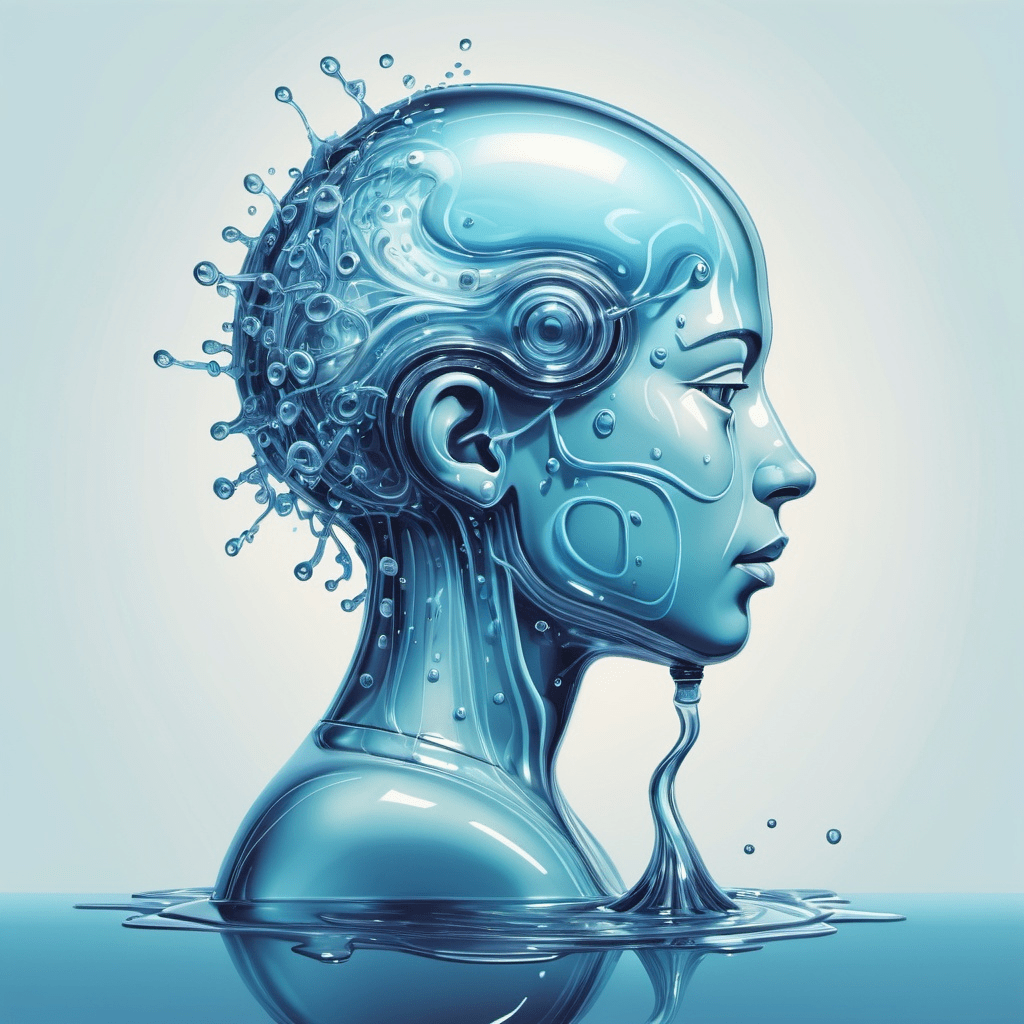
Although these are interesting images, we were seeking some some of fantastical image of some sort of non-human being sucking up water. So we asked again, adding non-human to the prompt. Openart.ai responded by rewording my prompt to “(decorative illustration of AI as a non-human entity), ethereal and surreal design, (soft glowing lights) surrounding the figure, vibrant colours blending harmoniously, intricate water patterns flowing around, conveying a sense of consumption and interaction with water, dreamy atmosphere, high quality, (ultra-detailed) visuals that evoke curiosity and wonder, imaginative background elements that enhance the theme.”
These images were created:


So the attempt to create a fantastical creature resulted in this image of a childlike female android! with Barbie-like breasts? Or is this how IA sees itself? I tried with another similar prompt and was given variations of these two images. The next prompt was “AI as a beast consuming water in an illustration” and this is what we got.

The reality is not so dreamy nor the consumption so elegant. While we spend hours perfecting our prompts to get the tools to give us what we see in our mind’s eye, AI is still a long way from becoming sentient. In the meantime, training AI is at a significant cost to environment and water.
AI uses and pollutes water through related hardware production. Producing the AI hardware involves resource-intensive mining for rare materials such as silicon, germanium, gallium, boron and phosphorous. Extracting these minerals has a significant impact on the environment and contributes to water pollution.
Kate Crawford says in Generative AI’s environmental costs are soaring — and mostly secret that “Generative AI systems need enormous amounts of fresh water to cool their processors and generate electricity. In West Des Moines, Iowa, a giant data-centre cluster serves OpenAI’s most advanced model, GPT-4. A lawsuit by local residents revealed that in July 2022, the month before OpenAI finished training the model, the cluster used about 6% of the district’s water. “
One of our key partners Awhiworld is doing significant work in the AI space and also looks at the broacher ethical issues. AwhiWorld recently faciliated a workshop on AI which was very insoghtful and they plan to run more AI education programs.
Shaolei Ren’s article How much water does AI consume? The public deserves to know explores the consumption of water and energy. Ren states that “While there have been efficiency gains elsewhere, the exponentially growing demand for AI has increased the water footprint.
For example, driven partly by the growth in AI, Google’s scope-1 onsite water consumption in 2022 increased by 20% compared to 2021, and Microsoft saw a 34% increase over the same period. Most big tech water consumption for server cooling comes from potable sources. Here, the consumed water is actually evaporated and “lost” into the atmosphere. ” Although it appears reassuring that “big techs have started replenishing watersheds to offset their cooling water consumption and achieve “water positive by 2030” for their data centres ” it is not clear how this will happen.
In https://www.aquatechtrade.com/news/industrial-water/aws-water-positive-2030 , the commitment of Amazon Web Services (AWS) plans to be water positive by 2030 by returning more water to communities than it uses in its direct operations is discussed.
“In India, AWS will continue its support to WaterAid to complete projects in Hyderabad and Andhra Pradesh, where five piped water systems and new groundwater recharge projects have been completed.
While we are proud of the progress we have made, we know there is more we can do.
Meanwhile in the UK, AWS is working with The Rivers Trust and Action for the River Kennet to create two wetlands on a tributary of the River Thames. The wetlands will recharge over 587 million litres of groundwater per year and improve water quality by receiving and treating polluted runoff from farms and roadways. “
At Treecreate we recognise the benefits of AI as tools to support our work and we do so with self awareness and the cognisance of how we ethically use these tools to augment our work. Our deliberate decision to use AI as a collaborator in the logo development for Weaving Water is with the awareness and recognition of the energy and water used to create the initial design. As with all our projects, the use of material and technology is considered in terms of its ecological footprint and use of resources.
 Treecreate